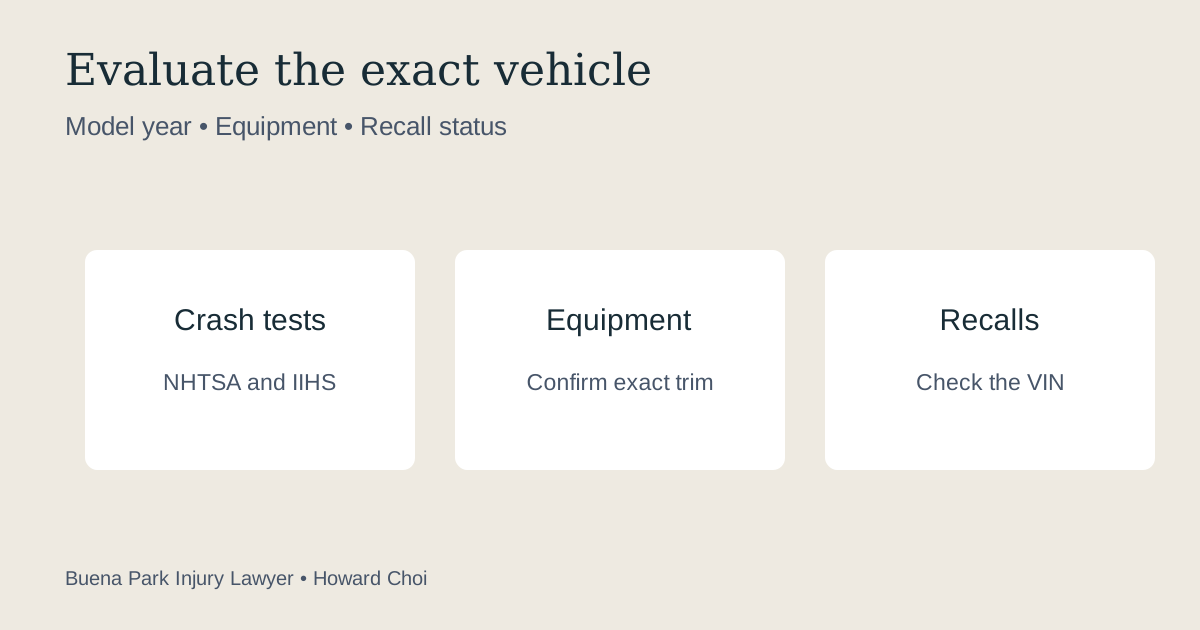
Finding a safe car takes more than choosing a familiar brand or counting driver-assistance features. Start with the exact vehicle’s crash-test results, installed equipment, and suitability for the people who will use it.
Volvo, Subaru, Tesla, Audi, Mercedes-Benz, Toyota, Honda, Ford, and Jeep all offer vehicles worth researching. None deserves a blanket safety endorsement. Results can differ by model, year, body style, trim, build date, and tested equipment.
Check current safety results for each model and year. Before buying, check the specific vehicle’s records with the National Highway Traffic Safety Administration and the Insurance Institute for Highway Safety. NHTSA safety ratings · IIHS safety awards
Equipment is only part of the picture. Read about avoiding skids and California’s minimum speed law for the role of road conditions and driving decisions.
Key point“Compare vehicle safety ratings, explore nine major brands, and learn what to check before buying a car and what to do after a California crash.”
Compare the cars you would actually buy
For each listing, record the model year, trim, and build date when available. Pull its NHTSA and IIHS results, then match any award conditions to the equipment on that listing. If one vehicle lacks a published result, leave that cell blank. A missing test result tells you what still needs checking. ·
What safety ratings tell you
NHTSA stars and IIHS awards measure different things
NHTSA’s five-star program evaluates frontal crashes, side crashes, and rollover resistance. Read the individual results, not just the overall score. Comparisons have limits. Frontal crash ratings, for example, should be compared among vehicles of similar weight and class, rather than across every vehicle category.
IIHS conducts separate crashworthiness and crash-avoidance evaluations. Its Top Safety Pick and Top Safety Pick+ awards depend on the requirements for that award year. Some apply only to certain headlights, equipment, or build dates. An older award does not show that a vehicle meets today’s requirements.
A missing rating does not automatically mean a vehicle is unsafe. It means that particular test result is unavailable. Similarly, a high overall score does not mean every individual result received the highest mark.
Crash protection is different from crash prevention
Crashworthiness describes how well a vehicle protects occupants during a collision. Crash-prevention features, including automatic emergency braking, aim to avoid certain collisions or reduce their severity.
Adaptive cruise control, lane-centering assistance, and warning systems have limits. Their presence does not mean a car can drive itself or prevent every crash. Compare each system’s tested performance and actual functions rather than relying on its marketing name.
Volvo
Volvo’s longstanding safety reputation is a reason to investigate its vehicles, not a substitute for checking them. For the XC40, check the results for the model year you are considering.
For a particular Volvo, confirm which collision-warning, pedestrian-detection, braking, and driver-assistance functions are installed. Adaptive cruise control and other equipment should not be assumed standard across all years and trims. Match the vehicle to its rating record.
Subaru
Availability and safety results for the Ascent, Crosstrek Hybrid, Legacy, and Outback depend on the model year.
Assess EyeSight equipment and all-wheel drive separately from crash protection. All-wheel drive does not replace suitable tires, adequate following distance, or careful braking. When reviewing an Ascent or another Subaru, check the particular test and award year. An “acceptable” result in one evaluation and an award from another period cannot establish a permanent safety ranking.
Tesla electric cars
The Tesla Model Y is another candidate for comparison. Electric propulsion and advanced software, however, do not establish overall safety superiority.
Keep crash-test results separate from claims about Autopilot or other assistance systems. Those names are not permission to stop supervising the vehicle. Read the operating instructions and understand when the driver must intervene.
Do not apply a historical Model Y rating to every production year or configuration. Confirm the relevant test record, then check the individual vehicle’s identification number, or VIN, for open recalls. These are separate checks. · NHTSA recall lookup
Audi
The Q4 e-tron, Q4 Sportback e-tron, Q5, Q5 Sportback, and Q8 are historical examples, not proof that every version currently holds an IIHS award.
Audi pre sense and other assistance systems can work differently across models. Ask what the specific vehicle detects, whether the system warns or intervenes, and which functions require optional packages. Look beyond luxury features to headlight performance, rear-seat protection, and the configuration covered by the rating.
Mercedes-Benz
Mercedes-Benz offers a broad range of safety technologies, but equipment varies. Do not assume blind-spot monitoring, parking sensors, lane assistance, or automatic braking is standard on every vehicle.
For a 2021 or 2022 GLE, check the NHTSA record for that model year. Also distinguish parking assistance from crash protection. A sensor that helps prevent a parking collision does not demonstrate occupant protection in a high-speed crash.
Toyota
The Avalon, Camry, Corolla, and Corolla Hatchback appeared in the original Toyota discussion. They remain research starting points, particularly for used-car shoppers, rather than a current safety ranking.
Toyota Safety Sense is a package name, not a promise of identical capabilities across vehicles. Verify its generation and installed features, including pedestrian detection, lane assistance, and automatic high beams. Check body style too. A sedan’s rating should not automatically be applied to a similarly named hatchback.
Honda
The Civic four-door sedan and Accord are useful candidates for model-specific research. Honda Sensing may include collision-mitigation braking, adaptive cruise control, and lane-related assistance, but availability and functions vary.
Families should also review available rear-seat test results, head restraints, and child-restraint installation information. If possible, bring your child seats when viewing the car to check everyday fit. Do not assume a Civic sedan’s results apply unchanged to another body style or generation.
Ford
Historical Ford examples include the Bronco Sport, Escape, Edge, and F-150 crew cab. These cover different sizes and vehicle types, so a single “safest Ford” label offers little practical guidance.
Ford Co-Pilot360 equipment varies. Confirm whether the vehicle includes blind-spot monitoring, automatic emergency braking, lane assistance, or reverse braking. For pickups, match the rating to the cab configuration. For SUVs, assess cargo space separately. Useful storage capacity is not evidence of crash performance.
Jeep
The Grand Cherokee, Wagoneer, and Grand Wagoneer need separate evaluations. Their size and weight do not establish superior crash protection or rollover resistance.
Read frontal, side, and rollover results individually. Verify whether the exact trim includes forward collision warning, automatic braking, blind-spot monitoring, and rear cross-traffic alerts. If passengers regularly use the second or third row, examine available rear-occupant evidence rather than relying only on front-seat results or an overall score.
A practical checklist before buying
Identify the vehicle precisely. Record the model year, trim, body style, drivetrain, build date, and VIN. A listing’s model name alone may not establish which test results apply.
Read both rating programs. Review individual results and any equipment or production-date restrictions. Ask whether the published evaluation covers the vehicle offered for sale.
Confirm installed features. Compare the window sticker or equipment record with the seller’s description. Ask for an explanation of warning systems, braking functions, and driver-assistance controls.
Check recalls separately. A crash rating does not establish whether an individual car needs a recall repair. Run the VIN through the official lookup before purchase, even if the seller says the car has been inspected. Recall status can change.
Check everyday fit and condition. Assess visibility, seating position, head restraints, child-seat fit, and understandable controls. For a used car, ask about collision repairs, maintenance, tires, and any required sensor calibration.
Hypothetical example. Two used SUVs have the same model name and year, but only one has the headlights required for an IIHS award. Both may be worth considering, but the seller should not present the award as applying to both.
Consumer Reports can offer additional shopping context. Use it alongside official test records, equipment checks, and an assessment of the individual vehicle’s condition, not instead of them.
What to do after a car accident
Even a highly rated vehicle cannot guarantee an injury-free outcome. Put immediate safety first, request emergency assistance when needed, and obtain appropriate medical care.
When safe, photograph vehicle positions, damage, and road conditions. Exchange identifying and insurance information and collect witness details. Keep medical records, repair estimates, photographs, and relevant communications. If a defect or failed safety system may be involved, seek advice about preserving the vehicle and electronic evidence before repairs or disposal. California Courts personal-injury guidance
Insurance coverage and responsibility
Crash ratings do not determine fault. Depending on the evidence, an investigation may involve another driver, an employer, a manufacturer, or an entity responsible for road conditions. Identifying the proper defendants is separate from determining which insurance policies may respond.
Liability, collision, comprehensive, uninsured or underinsured motorist, and medical payments coverage serve different purposes. Deductibles, exclusions, and limits affect available benefits. GAP coverage addresses a different financial risk and should not be confused with injury coverage. California’s standard minimum liability limits increased to $30,000 per injured person, $60,000 per accident for bodily injury, and $15,000 for property damage on January 1, 2025. Those minimums do not establish the value of a claim or guarantee sufficient coverage. California Department of Insurance coverage guide
California fault, damages, and filing deadlines
California’s comparative-fault rules can reduce damages when an injured person shares responsibility. They do not guarantee compensation. Evidence must still support liability, causation, and recoverable losses.
Economic damages cover financial losses such as medical expenses and lost income. Noneconomic damages address harms such as pain and suffering. Punitive damages require qualifying evidence and are not routine. Following a fatal collision, wrongful-death and survival actions are distinct claims with different available damages.
Personal-injury and wrongful-death claims often start with a two-year general filing rule. That is not a universal deadline. Government claims, delayed discovery, minors, medical malpractice, and other exceptions require individual review. Property-damage deadlines may also differ. Seek advice promptly rather than assuming one deadline covers every claim. California Courts deadline guidance
Legal advice may be especially useful when injuries are serious, fault is disputed, or a defect is suspected.
For a crash involving injuries, our car accident practice page explains the evidence and claim considerations.
Frequently asked questions
Which car brand is safest overall?
There is no reliable brand-wide answer. Compare the exact model, year, configuration, and equipment. Vehicles from the same manufacturer can have different test results, and older awards may reflect different testing requirements.
Is a five-star NHTSA rating the same as an IIHS award?
No. The programs use different evaluations and rating systems. Read both when available, including individual results and restrictions. Neither guarantees protection against injury. ·
Does a larger SUV automatically offer better protection?
No. Size alone does not establish overall safety. Review crashworthiness, rollover resistance, crash-prevention performance, and passenger needs. Follow NHTSA’s comparison limits rather than assuming equal stars across different vehicle classes mean identical protection.
Can automatic emergency braking or Autopilot prevent every accident?
No. Assistance systems may not detect or respond to every hazard. Follow the vehicle’s instructions and remain responsible for driving. A feature’s name does not establish that it can handle every traffic situation.
What should I check when a used car has an older safety award?
Confirm the award year, required equipment, and any build-date restriction. Review the vehicle’s condition and repair history, then check its VIN for open recalls. Recall status is separate from crash-test performance.
Can I pursue a California injury claim if I was partly at fault?
Potentially. Comparative fault may reduce recoverable damages, but it does not establish entitlement to payment. Evidence, injuries, coverage, and filing requirements still matter. Obtain advice about your circumstances rather than relying on a general deadline or an assumption about compensation.