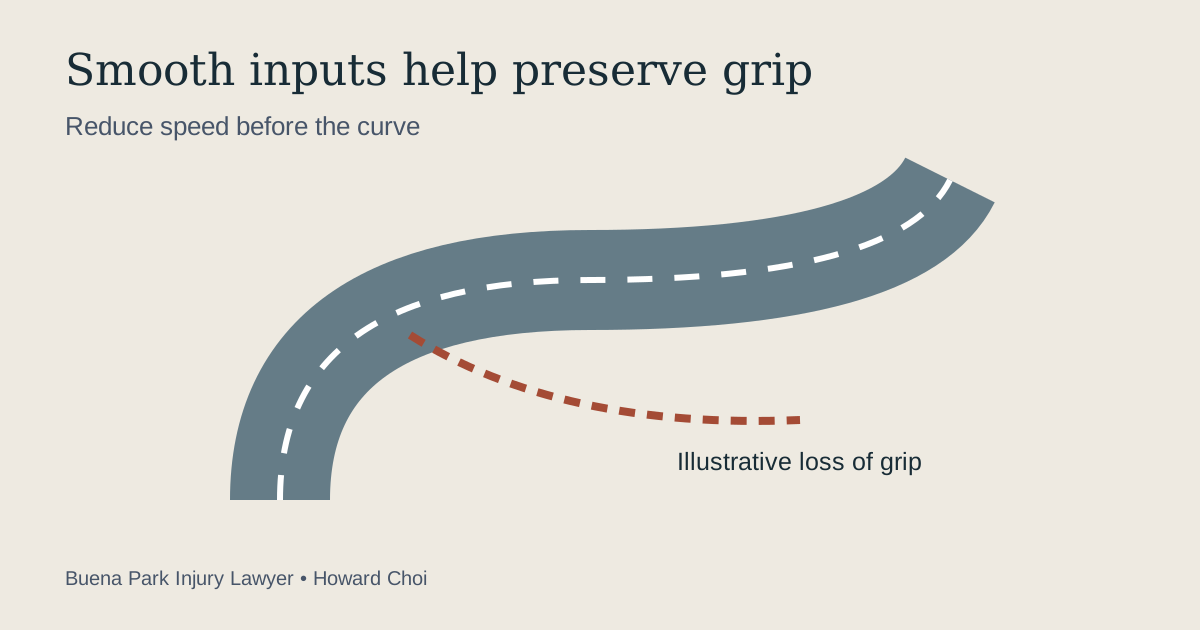
A car skids when its tires lose enough grip that the vehicle no longer follows the path the driver expects. You may turn the wheel and feel the front of the car continue wide. In another skid, the rear may swing to one side. The two events can feel similar in the first instant, but the part of the car that loses grip helps explain what is happening.
The most useful decisions happen before a skid starts. Set your speed for the surface, leave enough space to slow down gradually, and make steering and braking inputs smoothly. A driver approaching a wet curve should have already reduced speed before needing to turn. California Driver’s Handbook
Slowing for poor traction is different from unnecessarily obstructing traffic; see California’s minimum speed law. For vehicle equipment and crash-test comparisons, read how to evaluate the safest cars.
Key point“Learn how skids start, how understeer and oversteer feel, what changes with ABS, and what evidence matters after a skid-related crash.”
Use the approach to a curve to set your margin
Before a bend, pick a visible point where you can still slow in a straight line. If spray, glare, or a crest hides the rest of the curve, reduce speed before reaching that point. In traffic, increase the gap early enough that you can brake progressively if the vehicle ahead disappears around the bend and then stops.
Why tires lose grip
A tire has to share its available grip among accelerating, braking, and turning. A sharp turn can demand a large share of that grip. Add hard braking on a wet road and the tire may be unable to do both. The same turn that feels uneventful on a dry day can become difficult when water, ice, gravel, or debris reduces traction.
Speed is part of the problem because it leaves less time to notice a change in the road and increases the work the tires must do in a turn. A driver who waits to brake until halfway through a curve may have fewer options than one who slowed while traveling straight.
Tire condition matters as well. Check tread, pressure, and visible damage, and follow the vehicle manufacturer’s guidance on tire selection and inflation. Inspect tires before a long drive and after a hard impact with a pothole or curb. If a warning light appears, investigate its cause. The light is a reason to check the tire, even when it looks normal from the driver’s seat.
What different skids feel like
Understeer
Understeer happens when the front tires lose grip and the vehicle runs wider than intended. It can feel as though the steering wheel has stopped making much difference. Adding more steering can ask even more of the same front tires. Ease off the accelerator and avoid abruptly adding more steering or braking. As grip returns, guide the car back toward the intended path with measured inputs.
A familiar example is entering a wet bend too quickly. The driver has already turned the wheel, but the car drifts toward the outside of the bend. The better preventive move would have been to slow down before entering the bend. When there is room to recover, easing the demand on the tires gives them a chance to grip again.
Oversteer
In oversteer, the rear tires lose grip and the back of the vehicle starts to swing. That can happen if a driver makes an abrupt input in a turn, especially on a slippery surface. Look toward the path you want to take, ease off the accelerator, and steer smoothly to correct the slide. As the rear comes back into line, reduce the correction so you do not send the vehicle sliding in the opposite direction. Pennsylvania driver’s manual on skids
Hydroplaning
Hydroplaning can occur when water separates a tire from the road surface. The steering may suddenly feel light or unresponsive. Ease off the accelerator and avoid abrupt steering or braking while the tires regain contact. Reduce speed before reaching standing water and leave extra space when rain reduces visibility.
Locked-wheel skids and ABS
In a vehicle with conventional brakes, hard braking can lock the wheels and reduce steering control. The California handbook describes releasing the brakes in a locked-wheel skid so the wheels can roll again and steering can become effective. A vehicle with four-wheel anti-lock brakes calls for a different emergency braking response. The handbook advises applying firm brake pressure in the appropriate emergency. Do not pump four-wheel ABS. Learn which system your vehicle has and read its instructions before you need them.
Make the decision before the curve
Use the next stretch of road to decide whether you have enough margin. Look through the turn for standing water, a shaded icy patch, debris, or stopped traffic. Choose a speed that lets you turn without a sudden correction. Leave enough distance from the next vehicle that you can slow progressively if its brake lights come on.
Consider a downhill road with a wet bend and a car ahead. If the driver ahead brakes sharply, the following driver has three demands at once. The car is descending, it needs to turn, and it needs to slow. Increasing the gap and reducing speed on the straight approach gives the driver time to handle those demands separately. The same habit helps on a dry road when a curve hides stopped traffic.
Avoid abrupt accelerations when pulling away on slippery surfaces. Keep both hands ready to steer and give yourself time to notice how the vehicle responds. When visibility drops, ask whether you can see far enough ahead to stop or slow for a hazard. A posted limit gives you a legal reference point, while conditions determine what speed is reasonable. California DMV Basic Speed Law guidance
What vehicle safety systems can do
ABS helps manage wheel lock during braking. Stability and traction systems can help manage some losses of control. Their operation depends on the vehicle and the traction available. All-wheel drive can help a vehicle accelerate in some conditions, but tire grip still limits braking and turning.
Learn what the dashboard warnings mean. A flashing indicator during a slippery maneuver can be a signal to ease your inputs. A warning that remains on may indicate a fault. Consult your owner’s manual for the difference and arrange inspection where appropriate. If you want to practice responding to a loss of grip, use a professional driver training setting with controlled conditions.
Adjust your driving to the hazard you can see
Rain and standing water
Look farther ahead than the car in front of you. Spray behind a truck, pooled water near a curb, and a sudden change in pavement color can all prompt you to give yourself more space. Reduce speed while the vehicle is traveling straight and before it reaches the area that concerns you. If you cannot judge how deep the water is or whether a route is passable, choose a safe alternative rather than relying on the vehicle’s traction systems.
Visibility can change before you reach standing water. When you can see less, leave extra space for both your reaction and the car’s movement as you slow. A route that you drive every day can still hide an obstacle under different weather conditions.
Gravel, debris, and changes in pavement
A turn that begins on dry pavement may end on loose gravel at the shoulder. If one side of the car leaves the pavement, abrupt steering can make the situation harder to control. Review your driver’s handbook guidance on leaving the roadway before it happens. In routine driving, look for debris near construction entrances or shoulders and give yourself time to choose a safe path instead of swerving at the last moment.
Loose material is also a reason to consider the traffic behind you. Early, gradual slowing gives a following driver more time to respond. It also gives you space to reassess if the debris extends farther into the lane than it first appeared.
Cold mornings and shaded stretches
On a cold morning, pay extra attention to bridges and shaded portions of the road. Slow before reaching a stretch that looks slippery, and allow more time for every change in direction. Keep the route flexible. If conditions make it difficult to stay in control even at a reduced speed, finding a safe place to stop can be a better choice than continuing toward a more difficult stretch.
Check the car before you need to rely on it
Start with the tires. Use the manufacturer’s recommended pressure for the vehicle and check it when the tires are cold. Look for uneven wear or visible damage, and make an appointment if the car consistently pulls to one side, vibrates, or behaves differently under braking. An inspection is also a chance to ask whether your tires suit the conditions you regularly drive in.
Then check the information you would need in an emergency. Locate the owner’s manual, find the section on braking and stability controls, and learn which dashboard lights signal an active system and which can signal a fault. Two cars in the same household can have different controls. Each driver should know the basics of the vehicle they actually use.
Reconstructing a skid when accounts disagree
Suppose one driver says the other braked too late, while the other says a vehicle pulled into the lane with little warning. A photograph of the final positions can help establish where the vehicles stopped. It cannot establish when the first driver could see the hazard. Video, witness accounts, lane markings, and the view from the approach can help answer that earlier question.
Make a list of what each record can establish. A maintenance invoice may describe the work performed on a tire. A photograph may show damage after impact. A witness may remember where a vehicle entered the road. Compare those records against a timeline before assigning a cause. If a condition changed after the crash, such as a spill being cleaned up, record when the later observation was made.
Keep copies of insurer correspondence and note any request that has a deadline. If the vehicle is scheduled for repair, sale, or disposal and its condition is disputed, seek advice promptly about documenting or preserving relevant evidence. The opportunity to inspect a part can change once it has been replaced. California Courts personal injury guidance
If a skid leads to a collision
Get to a safe place if you can, call for emergency help when needed, and follow responders’ instructions. Once it is safe, record where the vehicles ended up, the direction they were traveling, and what the road surface looked like. Photograph relevant signs, sight lines, lane markings, debris, and damage without entering traffic. Save the original dashcam file and any recordings that show the moments before the slide.
Write down facts separately from conclusions. “I saw water across the right lane” is more useful than assuming that the other driver hydroplaned. A witness may be able to describe a braking maneuver or the position of a vehicle. A repair invoice may document a tire issue. Each piece of evidence answers a different question about what happened.
A skid alone cannot tell you whether someone acted negligently. A claim may turn on whether a driver took reasonable care under the circumstances, whether another party contributed to a hazard, and whether the conduct caused the injury and losses. Investigators may review speed, vehicle condition, maintenance, warning signs, and the timing of other vehicles’ movements.
What a personal injury claim may address
A claim usually requires evidence of a duty, a failure to meet it, a causal connection, and resulting harm. For example, a driver who slides on an unexpected patch of water may raise different issues from one who enters a clearly marked curve at a speed unsuitable for the conditions. The evidence matters more than the fact that both cars skidded.
Medical expenses, lost income, and property damage can be part of a compensatory claim. Other losses can include pain and limitations supported by the evidence. Punitive damages serve a separate purpose and require a qualifying legal basis. They should not be treated as a typical outcome of a skid-related crash.
Keep a record of expenses and work missed, along with the documents that support them. A running list can help connect each expense to the collision without relying on memory months later. If symptoms affect your daily activities, describe the specific activity and when the difficulty began. Medical records, work records, and photographs can help establish the sequence.
If you consult an attorney, bring your timeline, the collision report if available, repair estimates, and any correspondence with insurers. Flag evidence that may disappear quickly, such as footage from a nearby business or a temporary road hazard that has already been cleared. Ask what the attorney needs to verify and which records are likely to answer those questions.
For a crash involving injuries, our car accident practice page explains the evidence and claim considerations.
Frequently asked questions
How can I tell whether the front or rear tires lost grip?
A car that runs wide despite steering input is showing understeer. If the back of the car swings outward, it is showing oversteer. The distinction helps you understand which tires lost grip and why a sudden extra input can make recovery harder.
Should I pump the brakes in a car with four-wheel ABS?
No. In an emergency that calls for braking, apply firm pressure as described in the handbook and follow the vehicle manual. Conventional braking systems require different handling when the wheels lock.
What should I do if steering suddenly feels light in heavy rain?
Ease off the accelerator, keep steering inputs gentle, and give the tires a chance to regain contact. Increase your margin for the rest of the trip by reducing speed and leaving more room.
Does all-wheel drive make a car skid-proof?
All-wheel drive can help deliver power, while the tires still need enough grip to brake and steer. Speed, following distance, and tire condition remain important.
Can a driver be found at fault just because the car slid?
Investigators need facts about the driver’s choices, conditions, and cause of the crash. Save observations and records that help establish the sequence, including road conditions, sight lines, and video if available.